Starting your journey as a diving beginner opens a door to one of the planet's most incredible experiences. Beneath the waves lies a world of color, life, and wonder that few people ever explore. If you're considering learning to dive, you're about to join a global community of adventurers who've discovered the magic of breathing underwater. This guide covers everything you need to know as a diving beginner, from understanding basic principles to choosing your first course and making the most of your initial dives in destinations like El Nido, Palawan.
Why Take the Plunge as a Diving Beginner
The decision to become a diving beginner changes lives. You'll gain access to 71% of Earth's surface that remains largely unexplored by most people.
Key benefits of learning to dive include:
- Unique wildlife encounters – observe marine creatures in their natural habitat
- Physical and mental health – low-impact exercise combined with meditative breathing
- Global travel opportunities – dive sites on every continent (except Antarctica, unless you're very dedicated)
- Social connections – meet like-minded adventurers worldwide
- Personal achievement – overcome fears and build confidence through skill mastery
Many diving beginners worry about breathing underwater or being comfortable in deep water. These concerns are completely normal. Quality training programs address these anxieties systematically, building your confidence through progressive skill development in controlled environments before venturing into open water.
Understanding Basic Diving Physics for Beginners
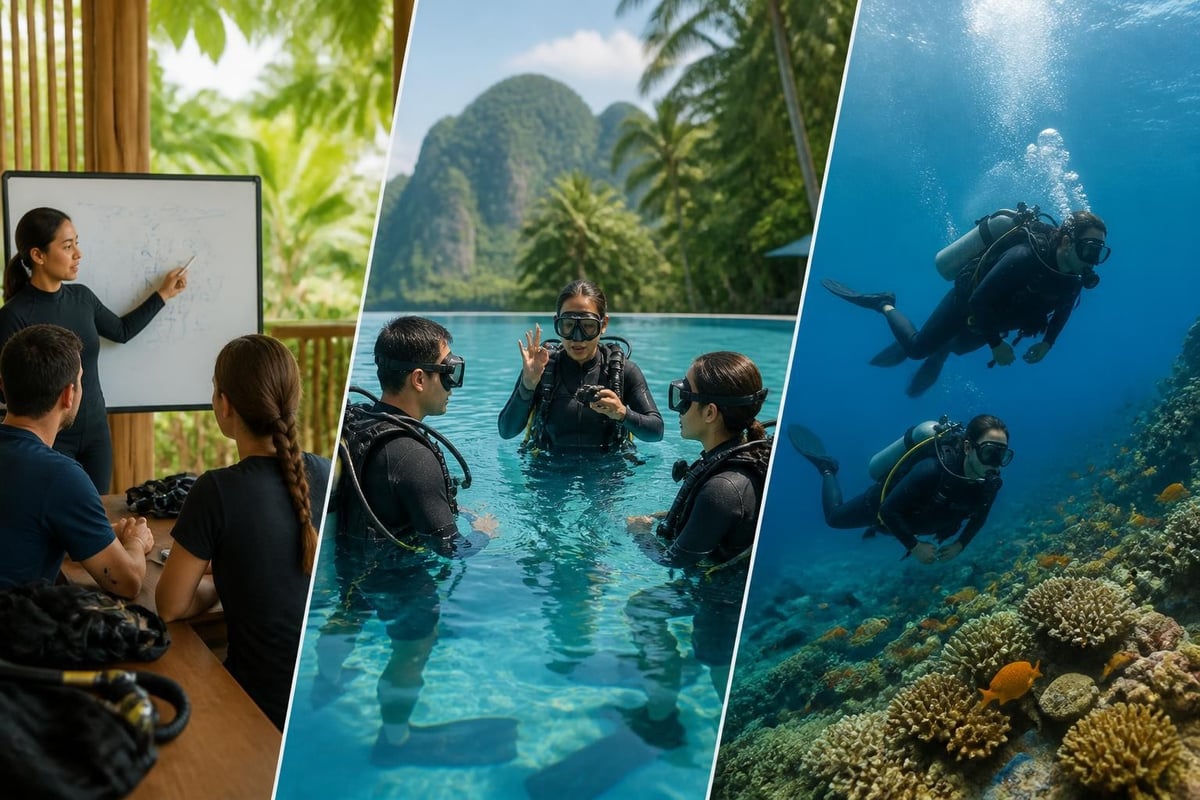
Every diving beginner needs to grasp a few fundamental principles about how pressure affects your body underwater. Don't worry – you don't need a physics degree, just a basic understanding that your instructor will explain thoroughly.
Pressure and Depth
Pressure increases by one atmosphere for every 10 meters (33 feet) you descend. At the surface, you experience one atmosphere of pressure. At 10 meters depth, you experience two atmospheres (the water plus the air above).
This pressure change affects air spaces in your body and equipment:
| Depth | Pressure (atmospheres) | Air Volume | Key Considerations |
|---|---|---|---|
| Surface | 1 | 100% | Normal breathing |
| 10m | 2 | 50% | First major pressure change |
| 20m | 3 | 33% | Buoyancy control becomes critical |
| 30m | 4 | 25% | Recreational limit for most beginners |
Equalization and Air Consumption
As a diving beginner, you'll learn to equalize the pressure in your ears and mask frequently during descent. This simple technique prevents discomfort and potential injury.
You'll also discover that you consume air faster at depth because the air is compressed. At 10 meters, each breath contains twice as much air (by weight) as the same breath at the surface. This is why monitoring your air supply and planning your dive profile matters from day one.
Choosing Your First Diving Course
The diving beginner has several entry pathways, but the most common starting point is either a Try Dive experience or a full certification course.
Discover Scuba Diving (Try Dive)
Perfect for the cautious diving beginner who wants to test the waters first. This introductory program lets you experience breathing underwater and basic skills in shallow water under close instructor supervision.
- Duration: Half day to one day
- Maximum depth: Usually 12 meters
- Certification: Experience only, no formal qualification
- Ideal for: Testing if diving suits you before committing to a full course
The Discover Scuba Diving program gives you a genuine taste of the underwater world while maintaining maximum safety through constant professional supervision.
Open Water Diver Certification
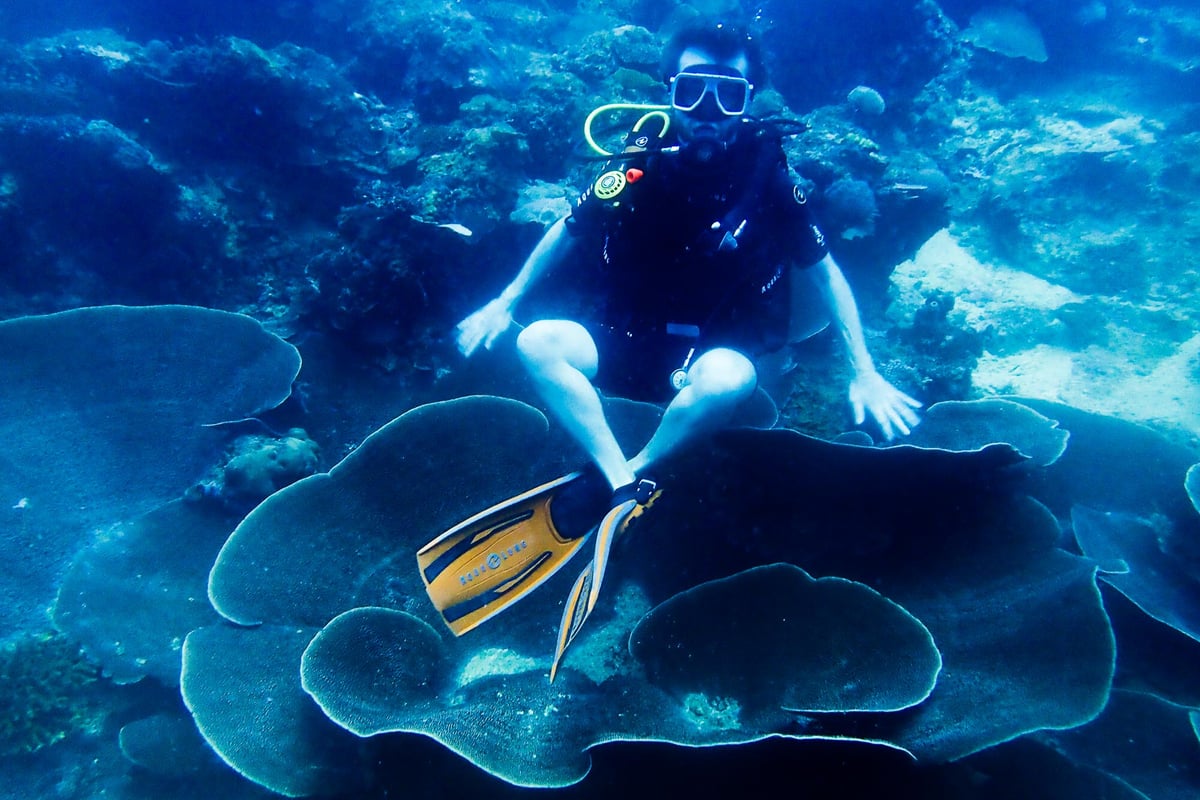
This comprehensive course transforms a complete diving beginner into a certified diver in three to four days.
Course components include:
- Knowledge development – theory sessions covering physics, physiology, equipment, and environment
- Confined water training – skill practice in a pool or shallow, calm water
- Open water dives – four dives applying your skills in the real ocean environment
- Assessment – demonstrating competence in essential safety and diving skills
Upon completion, you're certified to dive to 18 meters with a buddy anywhere in the world. This internationally recognized qualification from agencies like PADI, SSI, or BSAC opens countless diving opportunities.
Essential Equipment Every Diving Beginner Should Know
Understanding your gear removes mystery and builds confidence. As a diving beginner, you'll use rental equipment initially, but knowing how everything works is crucial.
Personal Equipment
Mask, snorkel, and fins are often the first items divers purchase because proper fit matters significantly for comfort.
Your mask creates an air space allowing you to see clearly underwater. It must seal comfortably without leaking. The snorkel is used primarily for surface swimming, conserving tank air. Fins transform your legs into efficient underwater propulsion.
Life Support Equipment
The scuba unit (Self-Contained Underwater Breathing Apparatus) includes several integrated components:
- Tank/cylinder – stores compressed air (usually 200-300 bar)
- Regulator – reduces high-pressure air to breathable pressure
- Buoyancy Control Device (BCD) – inflatable vest controlling your position in the water
- Gauges – monitor depth, time, air pressure, and sometimes temperature
Exposure Protection
Water conducts heat away from your body 25 times faster than air. Even in tropical destinations like Palawan, most diving beginners wear at least a 3mm wetsuit for thermal protection and to prevent scrapes from accidental reef contact.
Mastering Core Skills as a Diving Beginner
Your certification course focuses on fundamental skills that keep you safe and comfortable underwater. Practice makes perfect, and every diving beginner progresses at their own pace.
Buoyancy Control
Achieving neutral buoyancy (hovering weightlessly) is often the most challenging skill for a diving beginner to master. It requires coordinating breath control, BCD inflation, and proper weighting.
Benefits of good buoyancy control:
- Protects delicate coral reefs from accidental contact
- Reduces air consumption through efficient movement
- Improves your underwater photography
- Prevents uncontrolled ascents or descents
- Makes diving feel effortless and meditative
Regulator Skills
You'll practice recovering your regulator if it comes out of your mouth, clearing water from it, and even breathing from your buddy's backup regulator in an emergency. These skills seem strange initially but become second nature quickly.
Mask Clearing
Every diving beginner learns to clear water from their mask without surfacing. This essential skill eliminates panic if your mask leaks or floods. You'll practice partial and full mask clearing until it feels routine.
Safety Considerations for the Diving Beginner
Diving is statistically very safe when you follow training, respect your limits, and use common sense. Understanding potential risks and how to manage them is part of becoming a responsible diving beginner.
Pre-Dive Health Assessment
Certain medical conditions require evaluation before diving. Your instructor will provide a medical questionnaire. Conditions affecting ears, sinuses, heart, or lungs may need physician clearance.
DAN’s health and safety guidelines offer comprehensive resources about diving fitness and medical considerations. Being honest about your health protects you and your dive buddies.
The Buddy System
You'll never dive alone as a diving beginner. The buddy system provides mutual support, assistance, and emergency backup. You and your buddy check each other's equipment, monitor each other during the dive, and stay close enough to render immediate assistance if needed.
Conservative Dive Planning
Your certification teaches you to plan dives using tables or dive computers. As a diving beginner, always dive conservatively:
| Planning Factor | Conservative Approach | Why It Matters |
|---|---|---|
| Depth | Stay shallower than limits | More bottom time, less nitrogen absorption |
| Time | End dive with ample air | Safety margin for unexpected situations |
| Ascent rate | 9-10 meters per minute maximum | Allows safe off-gassing of nitrogen |
| Safety stop | Always perform 3-5 min at 5m | Further reduces decompression stress |
Where to Start Your Diving Beginner Journey
Location matters when learning to dive. Ideal conditions for a diving beginner include warm water, good visibility, gentle currents, and abundant marine life to make your first underwater experiences memorable.
Why El Nido, Palawan Stands Out
El Nido offers exceptional conditions for the diving beginner. The protected waters around Bacuit Bay provide sheltered dive sites with minimal current, perfect for skill development. Water temperatures hover around 27-29°C (80-84°F) year-round, requiring only light thermal protection.
Visibility frequently exceeds 20 meters, allowing nervous beginners to see clearly and feel less confined. The vibrant coral reefs host diverse marine life including turtles, reef sharks (harmless to humans), countless tropical fish species, and seasonal visitors like manta rays.
Advantages of learning in El Nido:
- Small class sizes with personalized instruction
- Multiple dive sites within a short boat ride
- Calm conditions suitable for nervous beginners
- Thriving reefs showcasing healthy marine ecosystems
- Experienced instructors familiar with beginner anxieties
Learning Versus Traveling to Dive
Some diving beginners complete certification in their home country before traveling to tropical destinations. Others prefer learning in warm, clear water as part of a vacation. Both approaches work.
Learning at home allows you to:
- Spread training across several weekends
- Complete classroom and pool work in familiar surroundings
- Dive immediately upon arriving at your tropical destination
Learning during your vacation means:
- Warmer water and better visibility during training
- Motivation from the exciting environment
- Combining learning with a memorable holiday experience
Developing Your Skills Beyond Certification
Completing your Open Water course is just the beginning. Every dive after certification continues your education as a diving beginner building experience and confidence.
Your First Dives After Certification
Your initial post-certification dives should be in conditions similar to or easier than your training. Don't rush into challenging environments like deep dives, strong currents, or limited visibility.
Consider these progressive steps:
- Dives 1-5: Shallow reefs (10-15m), minimal current, good visibility
- Dives 6-15: Gradually increase depth to 18m, explore different reef types
- Dives 16-25: Experience various conditions, perfect your buoyancy
- Dives 25+: Consider Advanced Open Water training, specialty courses
Returning to diving safely after any break in activity requires honest assessment of your comfort level and possibly a refresher session.
Advanced Open Water and Specialties
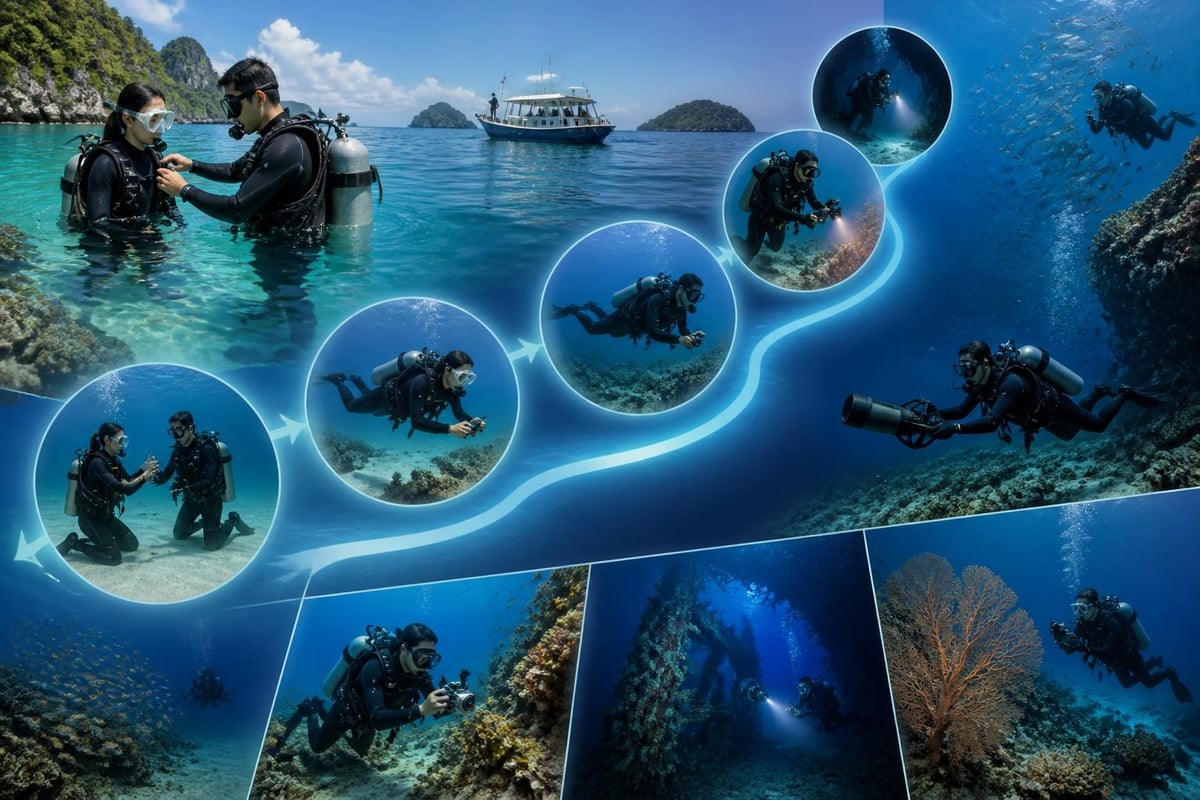
After gaining some experience, many diving beginners pursue Advanced Open Water certification. This course builds specific skills through adventure dives focusing on areas like:
- Deep diving (to 30 meters)
- Underwater navigation
- Night diving
- Peak performance buoyancy
- Wreck diving awareness
Specialty courses allow you to develop expertise in particular interests, from underwater photography to marine life identification to Nitrox diving for extended bottom time.
Common Challenges Diving Beginners Face
Understanding typical obstacles helps you prepare mentally and overcome them more easily.
Ear Equalization Difficulties
Some diving beginners struggle with ear equalization, especially if they have sinus congestion or anatomical variations. Never force equalization. If you can't equalize, ascend slightly until the pressure releases, then try again while descending more slowly.
Effective equalization techniques include:
- Gentle Valsalva maneuver (pinch nose, blow gently)
- Swallowing or jaw movement
- Toynbee maneuver (pinch nose, swallow)
- Starting equalization before descending
- Equalizing frequently (every meter or two)
Anxiety and Discomfort
Feeling anxious during your first dives is completely normal for a diving beginner. The environment is alien, the equipment feels strange, and you're doing something your brain recognizes as unusual (breathing underwater).
Strategies to manage anxiety:
- Communicate openly with your instructor about your concerns
- Practice skills until they become automatic
- Focus on slow, deep breathing
- Start in very shallow water and progress gradually
- Remember that your instructor is trained to handle nervous students
Mask Squeeze and Pressure-Related Discomfort
Forgetting to equalize your mask by exhaling slightly through your nose causes mask squeeze, where the mask presses uncomfortably against your face. This common diving beginner mistake is easily corrected once you're aware of it.
Environmental Awareness for the Diving Beginner
Part of your education as a diving beginner involves learning to dive responsibly and protect the underwater environments you're privileged to explore.
Reef-Safe Practices
Good buoyancy control is your primary tool for reef protection. Maintaining neutral buoyancy keeps you from crashing into or kicking coral. Even gentle contact can damage coral polyps that took decades to grow.
Additional reef-safe behaviors:
- Secure all equipment so nothing drags across the reef
- Never touch, chase, or harass marine life
- Don't collect shells, coral, or marine organisms
- Be aware of your fin position at all times
- Photograph memories instead of taking souvenirs
Understanding Your Impact
The diving beginner should recognize both the positive and negative impacts of recreational diving. Responsible divers become ocean advocates, supporting marine conservation through awareness and action.
Negative impacts (when divers don't follow proper practices):
- Coral breakage from contact
- Disturbance of marine life behavior
- Anchoring damage to reefs
- Pollution from boats and equipment
Positive impacts:
- Economic incentive for marine protection
- Citizen science opportunities
- Raising awareness about ocean issues
- Supporting sustainable tourism models
Planning Your Diving Beginner Holiday
Combining dive training with a tropical holiday creates an unforgettable experience. Proper planning ensures you maximize both your learning and your vacation enjoyment.
Timing and Season
El Nido offers diving year-round, though conditions vary seasonally. The dry season (November through May) generally provides the calmest seas and best visibility, ideal for a diving beginner. However, experienced instructors conduct training safely throughout the year.
Allow at least 3-4 full days for Open Water certification, plus additional time for arrival, departure, and rest days. A one-week trip gives you sufficient time to complete your course and enjoy a few additional fun dives to build confidence.
Accommodation Considerations
Staying close to your dive center eliminates daily transportation stress and allows you to rest between training sessions. The El Nido Dive & Stay Package combines beachfront accommodation with your diving instruction, offering the convenience of diving from your doorstep while staying in comfortable beachfront surroundings.
Budgeting for Your First Diving Trip
A diving beginner should budget for several components beyond just the certification course:
| Expense Category | Approximate Cost Considerations |
|---|---|
| Certification course | Typically includes instruction, materials, equipment rental, boat fees |
| Accommodation | Ranges from budget to boutique beachfront |
| Meals | Factor daily breakfast, lunch, dinner |
| Post-certification fun dives | Usually priced per dive or in packages |
| Equipment purchases | Optional: mask, fins, snorkel |
| Travel insurance | Essential, including dive coverage |
Most diving beginners find that investing in quality instruction pays dividends in comfort, safety, and enjoyment throughout their diving careers.
Building Confidence as a Diving Beginner
Confidence underwater comes from competence, which comes from practice. Every diving beginner progresses at their own pace, and that's perfectly acceptable.
Realistic Expectations
Your first dives won't feel graceful. You'll use more air than experienced divers, your buoyancy will be imperfect, and you'll feel slightly overwhelmed managing multiple tasks simultaneously. This is normal and expected.
By your fifth dive, you'll notice significant improvement. By your twentieth dive, skills begin feeling natural. By your fiftieth dive, you're no longer a diving beginner but an advancing diver with growing competence.
Continuing Education
The diving beginner who commits to lifelong learning becomes not just an adequate diver but an excellent one. Each course, each dive, each encounter with marine life adds to your knowledge and skills.
Consider joining online diving communities where you can ask questions, share experiences, and learn from others. Read diving publications, watch educational videos, and stay current with safety information and best practices.
The El Nido Diving Beginner Experience
Starting your underwater journey in El Nido, Palawan combines world-class diving instruction with a spectacular tropical setting. The region's combination of protected waters, diverse marine ecosystems, and experienced dive professionals creates an ideal environment for the nervous or excited diving beginner.
Beyond the diving itself, El Nido offers limestone karsts rising from turquoise water, hidden lagoons accessible only by boat, and pristine beaches perfect for surface intervals between dives. Your certification course becomes part of a broader adventure in one of Southeast Asia's most beautiful destinations.
Small group sizes ensure personalized attention during training. Instructors with years of experience teaching diving beginners understand common anxieties and adapt their teaching style to individual needs. This supportive environment helps you overcome fears and build genuine competence.
The marine life you'll encounter as a diving beginner in El Nido makes every dive a discovery. Healthy coral gardens provide habitat for thousands of species. Schools of fusiliers, parrotfish, and surgeonfish create constant motion. Patient searching reveals nudibranchs, shrimp, and tiny critters camouflaged among the coral. Larger animals like turtles and reef sharks add excitement while remaining completely harmless to humans.
Starting your journey as a diving beginner requires only curiosity, reasonable fitness, and a willingness to learn something completely new. The skills you develop, confidence you build, and underwater world you discover will reward you for years to come. Palawan Diving offers comprehensive training programs in El Nido's crystal-clear waters, with experienced instructors dedicated to transforming nervous beginners into confident, competent divers ready to explore the underwater world safely and responsibly.