Learning scuba diving how to properly opens up an entire underwater world, and there's never been a better time to start. Whether you're drawn to vibrant coral reefs, curious marine life, or simply the weightless freedom of exploring beneath the surface, scuba diving offers experiences unlike anything else on earth. This comprehensive guide walks you through every step of becoming a certified diver, from choosing your first course to mastering essential skills and planning your first ocean dives. With professional instruction and the right approach, you'll gain both the certification and confidence to dive safely in stunning destinations like El Nido, Palawan, where crystal-clear waters and abundant marine life create perfect conditions for new divers.
Understanding Scuba Diving Certification
Before you can explore underwater independently, you need proper certification from a recognized training agency. The most widely accepted scuba diving how to programs come from organizations like PADI, SSI, BSAC, and NAUI, with PADI being the most recognized worldwide.
Choosing the Right Entry-Level Course
The Open Water Diver certification is your gateway to recreational scuba diving. This course typically includes:
- Knowledge Development: Learning dive theory, physics, physiology, and equipment through online study, classroom sessions, or self-study materials
- Confined Water Training: Practicing skills in a pool or shallow water environment until you're comfortable and competent
- Open Water Dives: Four dives in real ocean conditions where you demonstrate mastered skills under instructor supervision
Most students complete their Open Water certification in three to four days, though the pace varies based on individual comfort levels and learning speed.
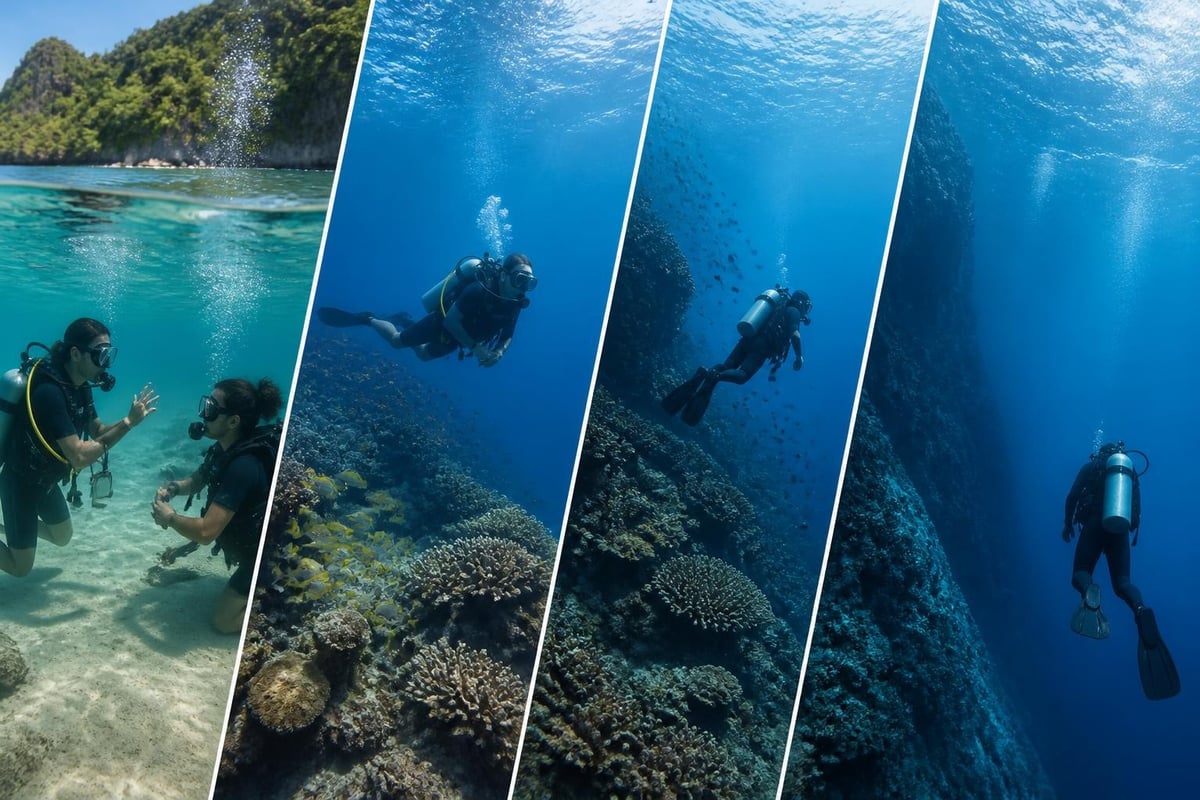
The PADI beginner’s guide provides detailed information about what you'll learn during your certification, while the BSAC Ocean Diver course offers an alternative perspective on core skills and training outcomes.
Try Before You Commit
If you're uncertain about committing to a full certification, Discover Scuba Diving programs let you experience breathing underwater with an instructor in a controlled environment. These introductory sessions include basic safety briefings, equipment familiarization, and a shallow dive where you'll practice a few fundamental skills.
This option works perfectly for travelers visiting dive destinations who want to test the waters before investing in full certification. Many people who start with an introductory experience quickly decide to pursue their Open Water certification.
Essential Skills Every Diver Must Master
Understanding scuba diving how to safely means developing muscle memory for critical skills that could save your life underwater. Your instructor will teach, demonstrate, and have you practice these skills repeatedly until they become second nature.
Core Competencies for Safe Diving
| Skill Category | Key Skills | Why It Matters |
|---|---|---|
| Breathing | Regulator use, breathing rhythm, never hold breath | Prevents lung overexpansion injuries during ascent |
| Buoyancy Control | Proper weighting, BCD inflation/deflation, trim | Protects reefs, conserves energy, controls depth |
| Equalization | Clearing ears and mask, managing pressure changes | Prevents barotrauma and discomfort during descent |
| Emergency Procedures | Out-of-air scenarios, buddy breathing, controlled ascents | Handles equipment failures and unexpected situations |
Mask clearing is one of the first skills you'll practice. Water will eventually enter your mask during dives, so knowing how to clear it calmly without surfacing is essential. You'll practice this skill until clearing a partially or fully flooded mask becomes automatic.
Regulator recovery teaches you to retrieve and clear your primary air source if it comes out of your mouth. You'll also learn to locate and use your alternate air source (octopus) and to share air with a buddy if needed.
Buoyancy: The Skill That Defines Good Divers
Achieving neutral buoyancy separates confident divers from struggling beginners. When properly weighted and trimmed, you hover effortlessly at any depth without finning or using your hands.
New divers often struggle with buoyancy because it requires:
- Proper weighting at the surface (enough to descend easily but not so much you're dragging on the bottom)
- Small BCD adjustments throughout the dive as your air consumption changes your overall weight
- Breath control using your lungs as a natural buoyancy compensator
- Body position maintaining horizontal trim to reduce drag and effort
Mastering buoyancy takes practice beyond your initial certification. Many divers benefit from taking a Peak Performance Buoyancy specialty course after gaining some dive experience.
Understanding Your Scuba Equipment
Knowing your gear inside and out is fundamental to scuba diving how to safely and comfortably. While equipment can seem complex at first, each piece serves a specific, logical purpose.
The Complete Scuba System
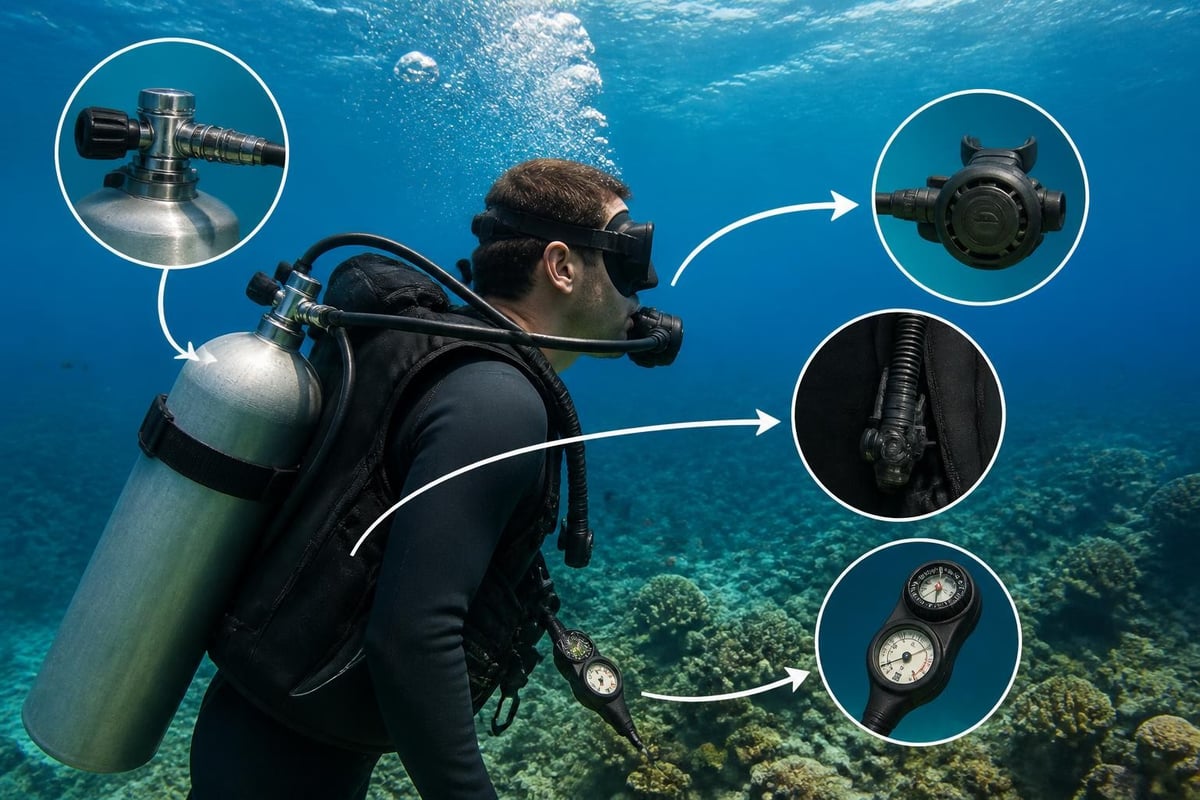
Your basic scuba setup includes several interconnected components:
- Mask: Creates an air space allowing your eyes to focus underwater; must seal comfortably around your face
- Fins: Provide efficient propulsion while keeping your hands free for tasks
- Exposure Protection: Wetsuit or rash guard protecting against cold, sun, and scrapes
- BCD (Buoyancy Control Device): Jacket or wing-style vest that holds your tank and controls your buoyancy
- Regulator System: First stage (attached to tank) and second stage (mouthpiece) that delivers breathable air on demand
- Alternate Air Source: Backup regulator for you or a buddy in out-of-air emergencies
- Gauges: Pressure gauge, depth gauge, and often a compass and dive computer
- Weight System: Belt or integrated weights to overcome your natural buoyancy
Rental vs. Personal Gear
Most dive centers provide all necessary equipment, which is ideal when you're starting out. As you gain experience, you'll want to invest in personal gear:
Buy First: Mask, snorkel, and fins. These items are inexpensive, travel easily, and proper fit significantly impacts your comfort. A leaking rental mask can ruin a dive.
Buy Eventually: Wetsuit, dive computer, and regulator system if you dive frequently. Personal gear fits better, performs more reliably, and you know its maintenance history.
Keep Renting: BCDs and tanks unless you dive constantly in one location. These items are bulky to travel with and represent significant investment.
Planning and Executing Your First Dives
Once certified, understanding scuba diving how to plan safe dives becomes your responsibility. Every dive requires preparation, buddy communication, and adherence to safety protocols.
The Dive Planning Process
- Check Conditions: Verify weather, visibility, currents, and sea state for your planned site
- Review the Site: Study depth, entry/exit points, potential hazards, and points of interest
- Plan Your Dive: Determine maximum depth, bottom time, air reserve requirements, and turning pressure
- Conduct Buddy Check: Use the BWRAF acronym (BCD, Weights, Releases, Air, Final check) before entering
- Brief Emergency Procedures: Agree on hand signals, lost buddy protocol, emergency ascent procedures, and surface meeting point
The NOAA Diving Standards provides institutional best practices for buddy systems and pre-dive procedures, while DAN’s Smart Guides offer comprehensive resources on dive planning and emergency action plans.
Following the Buddy System
Never dive alone. The buddy system is fundamental to recreational diving safety. Your buddy serves as:
- A second air source if your primary fails
- Assistance with equipment problems you can't solve alone
- Help in navigation or if you become disoriented
- Immediate rescue capability if you're injured or ill
- Extra eyes to spot marine life and potential hazards
Stay close enough to help each other (within a few meters) and maintain regular visual contact throughout the dive. Establish clear communication signals before descending.
Safe Diving Practices and Risk Management
Understanding scuba diving how to safely means recognizing and managing the unique risks of the underwater environment. While scuba diving has an excellent safety record when conducted properly, the physics of breathing compressed air at depth creates specific physiological challenges.
Preventing Decompression Illness
Decompression sickness (DCS), sometimes called "the bends," occurs when nitrogen absorbed during a dive forms bubbles in your tissues during ascent. Preventing DCS requires:
- Following dive table limits or computer guidance on depth and time combinations
- Making slow, controlled ascents (no faster than 18 meters per minute, often slower)
- Performing safety stops at 5 meters for 3-5 minutes on every dive
- Avoiding flying or high-altitude travel for at least 18-24 hours after diving
- Staying well hydrated before and after dives
- Diving conservatively when fatigued, cold, or after extended periods away from diving
A comprehensive review of decompression illness published in recent medical literature provides evidence-based guidance on DCS prevention and treatment.
Environmental Responsibility Underwater
Responsible divers protect the marine environments they explore. Practice these conservation-minded behaviors:
| Practice | Impact | How To Do It |
|---|---|---|
| Perfect Buoyancy | Prevents reef damage from contact | Stay horizontal, control descents, avoid touching bottom |
| Secure Gear | Reduces dragging equipment across corals | Clip gauges, secure hoses, streamline your profile |
| Look Don't Touch | Protects delicate marine life | Photograph from distance, never chase or harass wildlife |
| No Feeding | Maintains natural behaviors | Observe animals in their natural state without interference |
The REEF Surveyor Toolbox offers practical resources on minimizing diver impact and participating in citizen science surveys to support marine conservation.
Advancing Your Diving Education
After earning your Open Water certification, continuing education expands your capabilities and confidence. The Advanced Open Water course introduces you to specialties like deep diving, navigation, and night diving through five adventure dives.
Useful Specialty Certifications
- Enriched Air Nitrox: Dive longer on enriched air with less nitrogen, perfect for multi-dive days
- Deep Diving: Safely explore sites between 18-40 meters with proper planning and equipment
- Navigation: Master compass and natural navigation to find your way underwater and back to the boat
- Wreck Diving: Learn safe penetration techniques and wreck-specific hazards
- Drift Diving: Ride currents effortlessly while managing group cohesion and surface pickup
For those returning to diving after a break, many dive centers offer refresher courses to rebuild confidence and practice rusty skills before heading to open water. DAN’s guidance on returning safely covers medical considerations and recommended refresher training.
Starting Your Scuba Diving Journey in El Nido
El Nido, Palawan offers ideal conditions for learning scuba diving how to properly and gaining experience as a newly certified diver. The protected waters, excellent visibility, and diverse marine life create a supportive environment for building skills.
Why El Nido Works for New Divers
The dive sites around El Nido feature gentle conditions perfect for certification training and early post-certification dives:
- Calm, clear waters with 10-30 meter visibility most of the year
- Shallow reefs starting at 5 meters, ideal for skill practice and confidence building
- Minimal currents at many sites, reducing stress and air consumption
- Abundant marine life providing rewarding dives even at beginner-friendly depths
- Professional instruction with small class sizes and experienced local guides
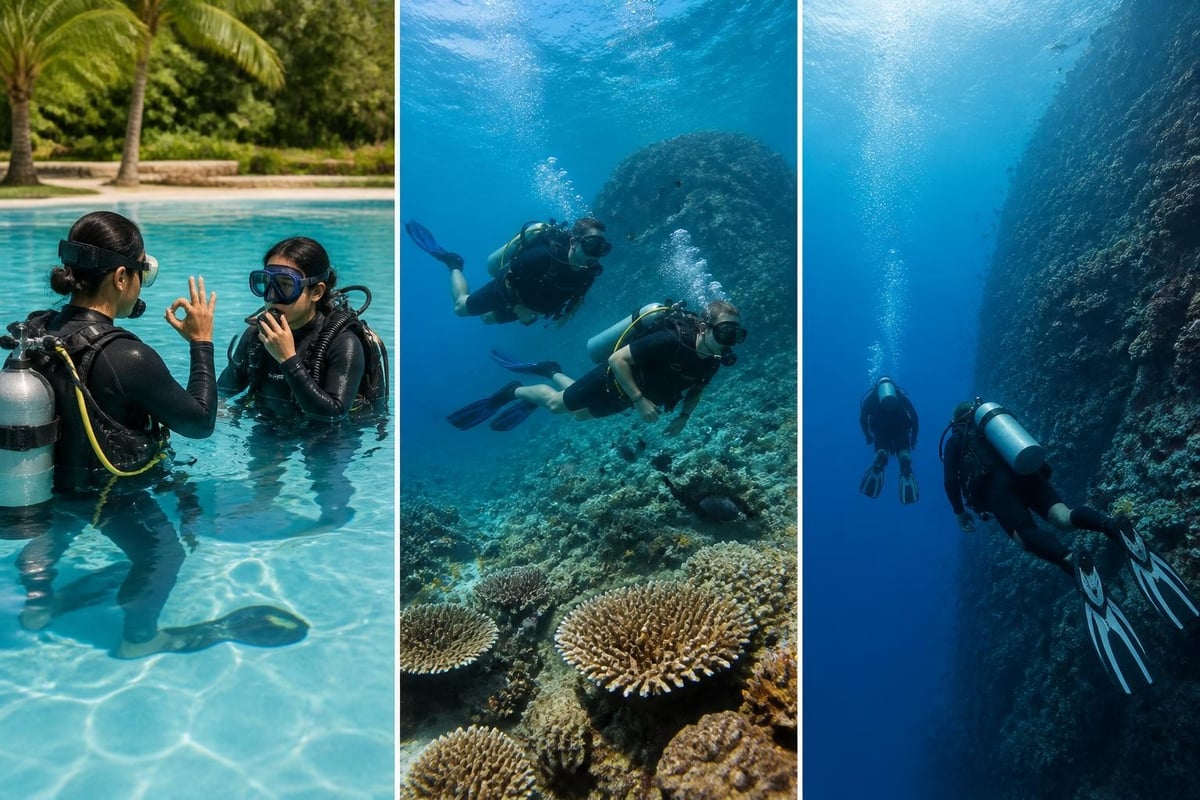
The beginner’s guide to diving in El Nido provides detailed information about what to expect during your first dives in the area, while why Palawan is the Philippines’ top dive destination explains what makes this region special for divers of all levels.
Dive and Stay Convenience
For travelers serious about learning to dive properly, combining your accommodation with your dive training offers significant advantages. When you're learning essential skills, convenience and comfort between training sessions matter.
The El Nido Dive & Stay Package combines beachfront accommodation at The Beach House with daily diving from Submariner Diving Center. You'll stay where you dive, with the boat departing directly from the beach in front of your room. Between training sessions, you can relax at Cloud 9 rooftop restaurant and bar, review your course materials, or simply rest before your next dive.
This integrated approach eliminates transportation between hotels and dive centers, letting you focus entirely on your training and enjoying your El Nido experience.
Building Experience After Certification
Getting certified is just the beginning. Understanding scuba diving how to truly well comes from accumulating dives, practicing skills, and gradually expanding your comfort zone.
Your First 20 Dives
- Dive frequently in the months after certification to solidify skills while they're fresh
- Start shallow and gradually increase depth as your comfort and air consumption improve
- Practice one skill deliberately each dive (buoyancy, navigation, air management, etc.)
- Vary conditions slowly, trying different entry types, slightly stronger currents, and various visibility
- Keep a logbook recording depth, time, conditions, marine life, and personal observations
Most divers find their air consumption improves dramatically over their first dozen dives as they relax, breathe more naturally, and move more efficiently through the water.
Common New Diver Challenges
Over-weighting is nearly universal among beginners. If you're constantly adding air to your BCD during the dive or struggling to stay down at the safety stop, you're probably carrying too much lead. Remove a kilo or two and reassess.
Task loading happens when you're trying to manage multiple skills simultaneously. Focus on one thing at a time: get your buoyancy right, then work on your trim, then add photography or marine life identification.
Air consumption anxiety concerns many new divers. Your air will last longer as you relax and gain experience. Breathe normally, dive shallow when possible, and communicate with your buddy about turning the dive before you reach reserve pressure.
Medical Considerations and Fitness to Dive
Certain medical conditions preclude safe scuba diving. Before beginning your certification, you'll complete a medical questionnaire screening for conditions that create elevated risk underwater.
Conditions That Affect Diving
- Respiratory Issues: Asthma, chronic bronchitis, or history of spontaneous pneumothorax may disqualify you
- Cardiovascular Problems: Heart disease, irregular rhythms, or high blood pressure require medical clearance
- Ear/Sinus Issues: Chronic congestion or inability to equalize pressure prevents safe diving
- Neurological Conditions: Seizure disorders or history of stroke create significant risk
- Diabetes: May be acceptable with proper management and medical approval
If you answer "yes" to any medical questionnaire items, you'll need clearance from a physician familiar with dive medicine before training. This isn't meant to exclude people, but to ensure your safety in an environment where immediate medical help isn't available.
Physical Fitness Requirements
Scuba diving doesn't require elite athleticism, but you should maintain reasonable fitness. You need to:
- Swim continuously for 200 meters or snorkel 300 meters without stopping
- Tread water for 10 minutes without assistance
- Handle your equipment (tanks, weight belts) without assistance
- Manage surface swims with full gear in moderate conditions
- Climb a boat ladder while wearing equipment
Building your swimming fitness and comfort in water before starting certification makes the course more enjoyable and helps you focus on diving skills rather than basic water comfort.
Continuing Your Diving Adventures
Once you've mastered scuba diving how to fundamentals, an entire world of diving opportunities opens up. From exploring local sites to planning international dive trips, your certification is a passport to underwater adventure.
Types of Diving Experiences
Beyond basic recreational diving, you might explore:
- Liveaboard Diving: Multi-day trips staying aboard a dive boat, accessing remote sites with 3-4 dives daily
- Technical Diving: Extended-range diving beyond recreational limits using specialized equipment and gas mixtures
- Underwater Photography: Capturing the underwater world through still images or video
- Scientific Diving: Contributing to research projects and citizen science initiatives
- Dive Travel: Exploring world-class destinations like the Great Barrier Reef, Red Sea, Maldives, or Philippines
Each diving experience builds your skills, confidence, and underwater awareness. You'll develop favorite environments (walls, wrecks, coral gardens, macro life) and may pursue specialized training to access them more fully.
The top dive sites in Palawan showcases some of the incredible diving available in this region, while information about diving resorts in the Philippines helps you plan broader dive travel throughout the archipelago.
Maintaining Your Skills
If you take extended breaks from diving, your skills will deteriorate. Maintain your proficiency by:
- Diving at least several times per year, ideally more frequently
- Taking a refresher course if you've been away from diving for more than a year
- Reviewing dive theory and procedures periodically
- Staying current with equipment technology and safety practices
- Keeping your certification cards and logbook accessible
Most importantly, dive within your current skill level and experience. Don't let anyone pressure you into a dive that exceeds your comfort zone or training.
Learning scuba diving properly requires quality instruction, deliberate practice, and a commitment to safety, but the rewards of exploring underwater environments last a lifetime. Whether you're drawn to vibrant coral reefs, fascinating marine life, or simply the unique sensation of weightless exploration, proper training gives you the skills and confidence to dive safely anywhere in the world. Ready to start your underwater adventure in El Nido's crystal-clear waters? Submariner Diving offers professional PADI courses, experienced instructors, and convenient dive and stay packages that let you learn in one of Southeast Asia's most beautiful diving destinations.