An underwater cave is a flooded cavity in rock, formed by sea or groundwater, where divers can swim beneath a solid ceiling with no direct path to the surface. For beginners in El Nido, the realistic starting point is not penetrating a cave at all: it is getting certified, building buoyancy skills, and then looking at cave entrances and swim-throughs with a professional guide who picks sites to suit your experience and the day's conditions.
What Is an Underwater Cave?
An underwater cave is any submerged void in rock large enough for a diver to enter, and it falls into two broad types: sea caves cut by waves and flooded caves dissolved by water over long periods.
Limestone is the main ingredient. Palawan is a limestone-rich region, and El Nido's karst cliffs are the same type of rock that produces caves above and below the waterline. Some of those cavities stay dry, some flood with the tides, and some sit fully underwater. Rainwater and groundwater slowly dissolve limestone, widening cracks into passages, while waves hammer at the base of sea cliffs and carve notches that deepen into chambers. A single cave can show both processes at once, which is why two openings that look alike from a boat can feel completely different once you are inside.
Divers care about one feature above all: the overhead environment. When a ceiling sits between you and the surface, you cannot make an emergency ascent. That single fact shapes every rule, every piece of equipment and every training requirement that follows. It also explains why a short passage that seems harmless in daylight is treated with real respect by trained divers.
Cavern, Cave and Swim-Through: What's the Difference?
Cavern diving stays inside the daylight zone, while cave diving goes beyond it, and the gap between those two is where most beginner confusion starts.
Scuba Diving magazine describes cavern diving as taking place in an overhead environment but within the daylight zone, where divers can return to the surface without navigating beyond that zone. Once you leave natural light behind, you are cave diving, which is a different discipline altogether.
Here is how the three compare in practice:
| Type | Natural light | Typical training needed | Beginner status |
|---|---|---|---|
| Swim-through or arch | Light visible throughout, open at both ends | Open Water, good buoyancy | Often suitable with a guide |
| Cavern | Daylight zone only | Specialty cavern training | Not for uncertified divers |
| Cave | Beyond the daylight zone | Full cave training and equipment | Advanced technical diving |
You will also hear a related question: what is the difference between a cave and a cavern in everyday speech? Outside diving, "cavern" simply means a large cave. In diving, the word has a precise safety meaning tied to light and distance from the exit.
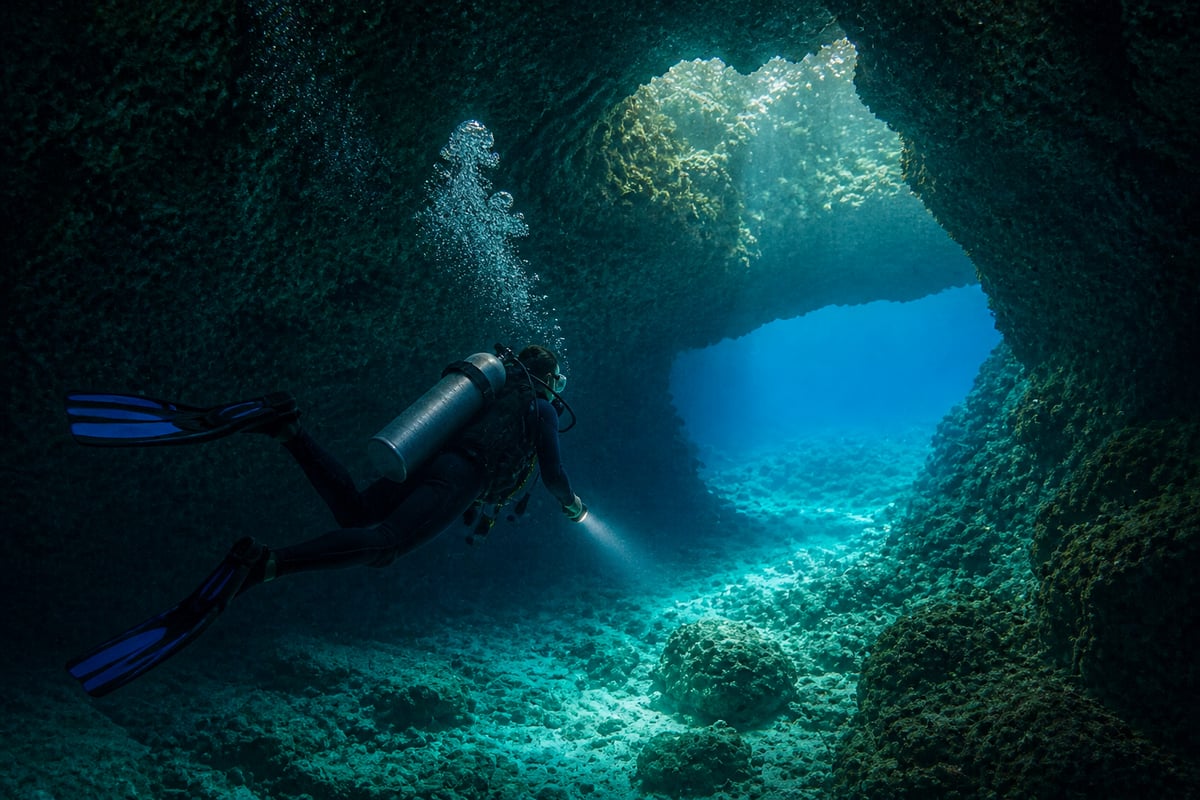
Why an Underwater Cave Is Not a Beginner Dive
An underwater cave demands training because an overhead environment removes your safety margin: no free ascent, silt that can erase visibility in seconds, and gas that must cover the whole round trip.
The SDI/TDI article on cave diving dangers explains why overhead environments need specialized training and outlines the progression from cavern to cave courses. Training agencies set firm minimums. SSI’s Cave Diving standards require at least six overhead training dives and at least one confined-water skills session totaling one hour. They also require at least 5 meters of visibility at the start of overhead training dives.
Those numbers describe a course for divers who already hold advanced qualifications. They are a useful reality check for anyone who sees a cave on social media and wants to try it on a holiday afternoon.
The main hazards in an overhead setting are worth knowing:
- Silt-out: fine sediment kicked up by fins can drop visibility to zero.
- Gas management: you plan gas for the swim in, the swim out and a problem in between.
- Navigation: guide line skills and exit awareness are learned, not intuitive.
- Light failure: every diver carries redundant lights for this reason.
- Task loading: a stressed diver in a confined space makes poorer decisions.
The Skills You Build Before Any Overhead Dive
The skills that prepare you for any overhead environment are buoyancy control, trim, finning technique and calm gas awareness, and you can start building every one of them on ordinary reef dives.
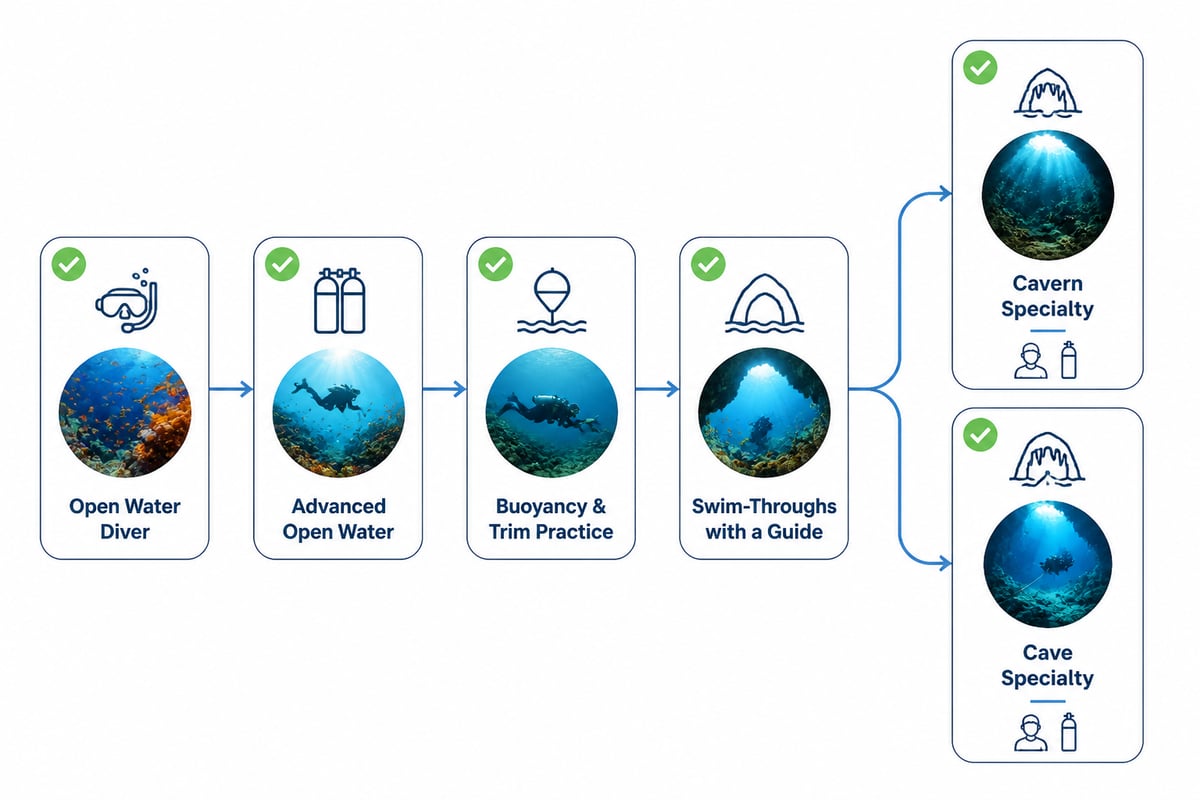
Good buoyancy is the foundation. A diver who hovers motionless at a chosen depth without touching the reef is far safer near a ceiling, because there is no flailing, no bumped head and no silt cloud. Practice it deliberately: hover mid-water on a shallow dive, stay level, and breathe slowly. A simple test is to hold your depth for a full minute using only your breathing, without kicking or adding air. Fine-tuning your weighting with your instructor makes this far easier.
Trim comes next. Keeping your body horizontal stops your fins dropping toward the floor, and it keeps your profile small when passing through narrow gaps. Finning style matters too. The frog kick and modified techniques move water backward rather than down, which protects visibility for everyone behind you. Over a sandy bottom, try both kicks and look back at the sand to see which one disturbs it less.
Gas awareness is the quiet skill. Experienced divers watch their gauge as a habit, not a reaction. Build that habit early and you carry it into every environment. Checking your gauge at set moments, such as every few minutes and at each change of depth, turns it into routine instead of worry.
Underwater Cave and Overhead Diving Around El Nido
El Nido's underwater terrain includes arches, walls, swim-throughs and some deeper tunnel structures, and which of them suit you depends on certification level and the day's sea conditions.
The limestone that makes El Nido's islands so dramatic also shapes the seabed. That does not mean every site is a beginner site. A 2026 dive guide from Philippine Dives lists Dilumacad Tunnel at 12 to 40 meters and rates it advanced, rather than a beginner dive. That rating is a good example of why site selection matters: a feature that looks like an adventure on a map can sit well beyond an Open Water diver's limits.
I would never promise a particular cave or tunnel experience for a given day. Currents, swell, visibility and tides change what is sensible, which is why a flexible approach beats a fixed itinerary. For a broader look at what the region offers, the El Nido underwater exploration guide and the write-up on cave adventures in Palawan give useful context before you plan dives.
How Submariner Diving Center Picks Sites for Your Level
Submariner Diving Center chooses dive sites daily by your experience, your interests and the sea conditions, so a beginner and an advanced diver on the same trip are not sent to the same place.
The center has over 15 years of diving experience in El Nido and offers private diving charters, PADI courses and dive packages, with local knowledge and modern safety equipment. For anyone curious about overhead features, that local knowledge is the useful part: an instructor who dives these waters regularly knows which structures are open and well lit, which collect silt, and which belong strictly to advanced divers.
Logistics help too. Guests who stay at The Beach House, a beachfront property, have the dive center in the same building, with boats and equipment close at hand. That removes the early-morning transport across town and means a calm-sea window can be used quickly. After a dive, the Cloud 9 rooftop restaurant and bar is a pleasant place to talk through what you saw. If you are planning a longer trip, the guide to dive resorts in the Philippines shows how accommodation and diving fit together.
Getting Certified First: The Realistic Path
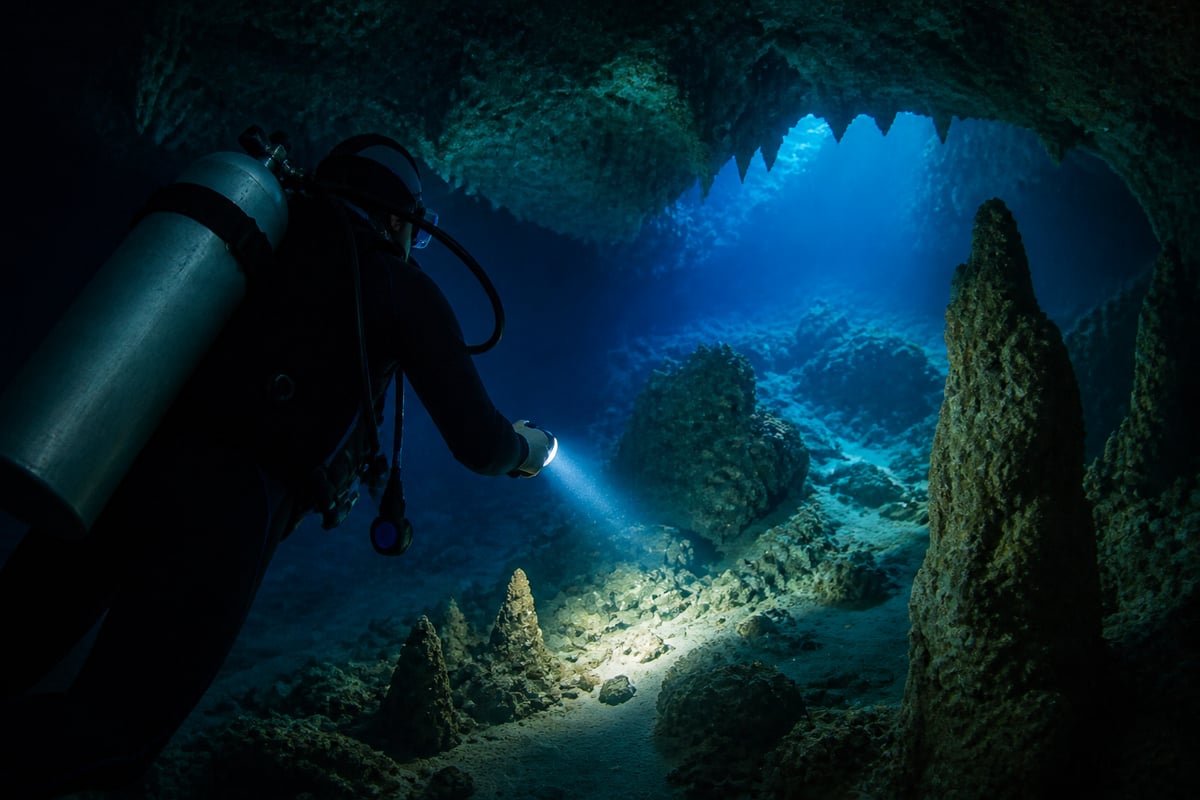
The realistic path to any overhead dive starts with an Open Water certification, then more experience, then specialty training under an agency instructor.
If you have never dived, the first step is a course that teaches you the basics in safe, shallow water. The Open Water Diver Course at Submariner Diving Center is taught by experienced instructors in small classes, and it gives you the qualification you need to dive independently with a buddy within its limits.
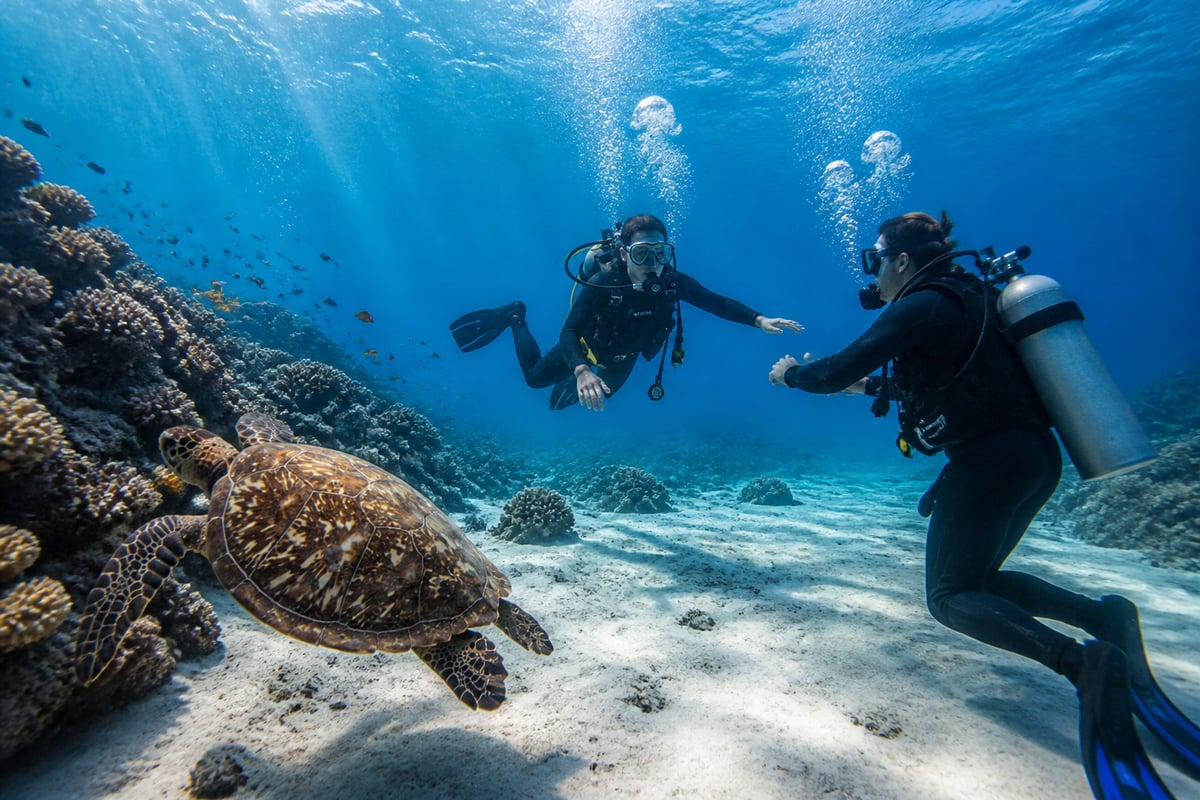
The Open Water Diver Course is the entry point, and the order of progression matters more than speed. A sensible sequence looks like this:
- Complete Open Water certification.
- Log dives and focus on buoyancy, not depth.
- Take an advanced course to widen your skills.
- Dive with a guide at sites that include swim-throughs and arches.
- Only then consider cavern or cave training with a qualified agency instructor.
Certified divers visiting for a dedicated trip can use the same logic. Even experienced reef divers are beginners in an overhead environment, and a cavern course is the honest next step. If your trip also includes the Philippines' remote reef sites, the Tubbataha complete guide covers that separately.
Gear and Preparation for Overhead Environments
Cavern and cave diving use redundant equipment: more than one light, more than one source of breathing gas, and a cutting tool, all configured and rehearsed before the dive.
Recreational reef gear is not enough on its own. Divers in training carry a primary light and backups, a guide reel or line, and often a configuration that keeps gas and gear streamlined against snags. Your instructor sets the standard, and it is worth following exactly.
Preparation is also physical and mental. Rest well, keep hydrated, and skip alcohol the night before. Plan a conservative dive, and agree a turn point and a gas limit with your buddy before getting in. A calm briefing is a good sign: it means everyone knows the plan and the exit.
If snorkeling is more your speed on a rest day, the comparison of snorkeling and scuba diving helps you choose, and the page on how scuba diving works is a good primer for first-timers.
FAQ
Are there any underwater caves?
Yes, underwater caves exist all over the world, from flooded limestone systems inland to sea caves along rocky coastlines. They form where water dissolves or erodes rock and the resulting cavities end up submerged. Many are popular with trained divers, while others are too fragile or dangerous to enter.
What is the term for someone who explores underground caves?
A person who explores caves on foot is a caver or spelunker, and someone who explores flooded caves with scuba gear is a cave diver. Cave diving is a distinct discipline with its own training, equipment and safety rules, separate from ordinary recreational diving.
What US state has the most underground caves?
Tennessee is commonly cited as the US state with the most known caves, though exact counts vary by source and by how a cave is defined. For divers specifically, Florida is better known because of its flooded limestone cave systems. Neither answer applies directly to planning a trip in El Nido.
Your next step is simple: decide whether you are starting from zero or building on existing certification, and plan dives to match. If you are new, the Open Water Diver Course is the place to begin, and certified divers can ask about a private charter with sites chosen for their level and the day's conditions. The team at Submariner Diving Center, based beside The Beach House, can help you plan around the weather and your goals, so Book Your Diving and get a trip built around what you want to see.